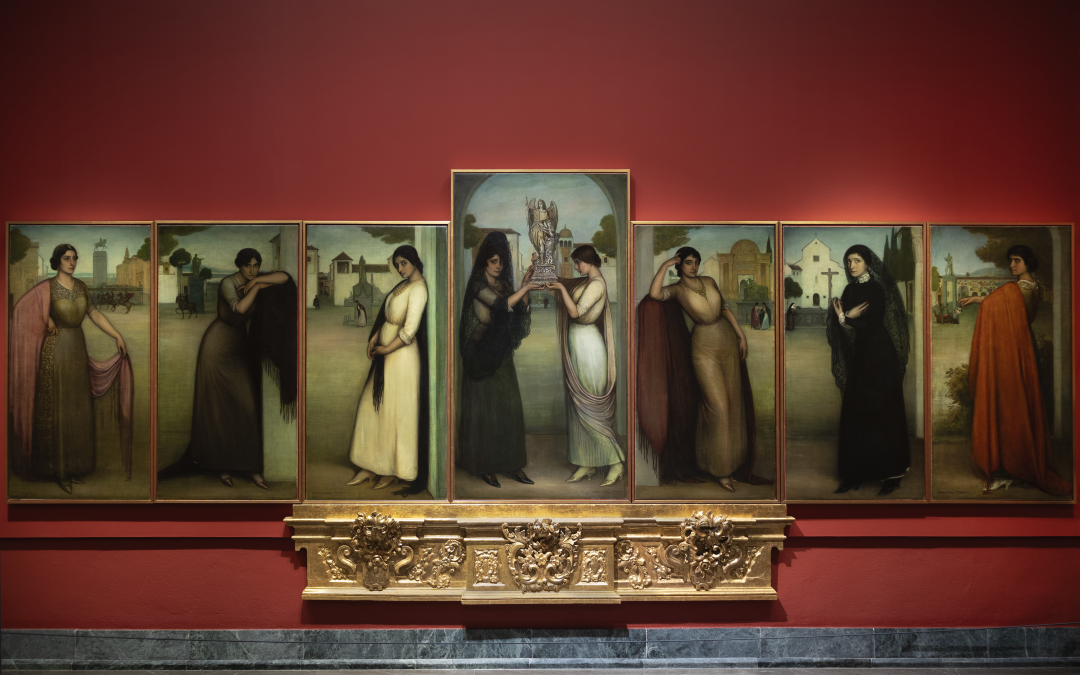
Finally, the last panel represents “The Bullfighter Cordoba” symbolized in the bullfighter “Lagartijo”. The model wears in a loosely way a red shawl in which a wealthy golden trimmed of her dress can be appreciated. She is holding a red...
In the sixth panel appears a young woman wearing a black dress white laced on its cuffs and neck and a blond lace mantilla. Her hands are crossed over her breast. Mr. Romero de Torres wants to represent “The Religious Cordoba”. As a background, there is a...
In the fifth panel, the female figure represents the “Roman Córdoba”. She is wearing an earth-colored dress, trimmed in gold on its neckline, and a fine pearls necklace. Her body is mold like a classical statue, propped over a pedestal and covered by her...
The central panel, larger than the others, refers to “The Christian Córdoba”. Two female figures are holding a Triunfo de San Rafael (Statue of San Rafael) under an arch. That symbolizes the devotion of the whole Córdoba society to his Guardian Angel. The...
The third panel represents the “Jewish Cordoba”. A woman is leans back lazily on a lintel of a door. That door leads to a Square with a monument of the poet Maimonides in the center. In the distance, the Fuenseca Square and the Portillo Alley are depicted....
The second panel is the “Baroque Córdoba”. In a foreground, a woman is wearing a white dress and a black shaw, lying on a pedestal. Engrossed on her thoughts, she is looking in an indolently way to the horizon. As a backdrop there is a square where it can...
In the first left panel it is depicted the “Cordoba of the Great Captain or Cordoba Warrior”. In the foreground appears a young girl luxuriously dressed, wearing an embroidered dress and a red shawl. At the background there is an imaginary square where it...
This composition, full of lyricism, was defined by Romero de Torres as the reincarnation of past in present. It was painted in 1915, when the artist subscribed the School of Allegorists. In spite of the devotion professed to the Italian Renaissance, he never left...
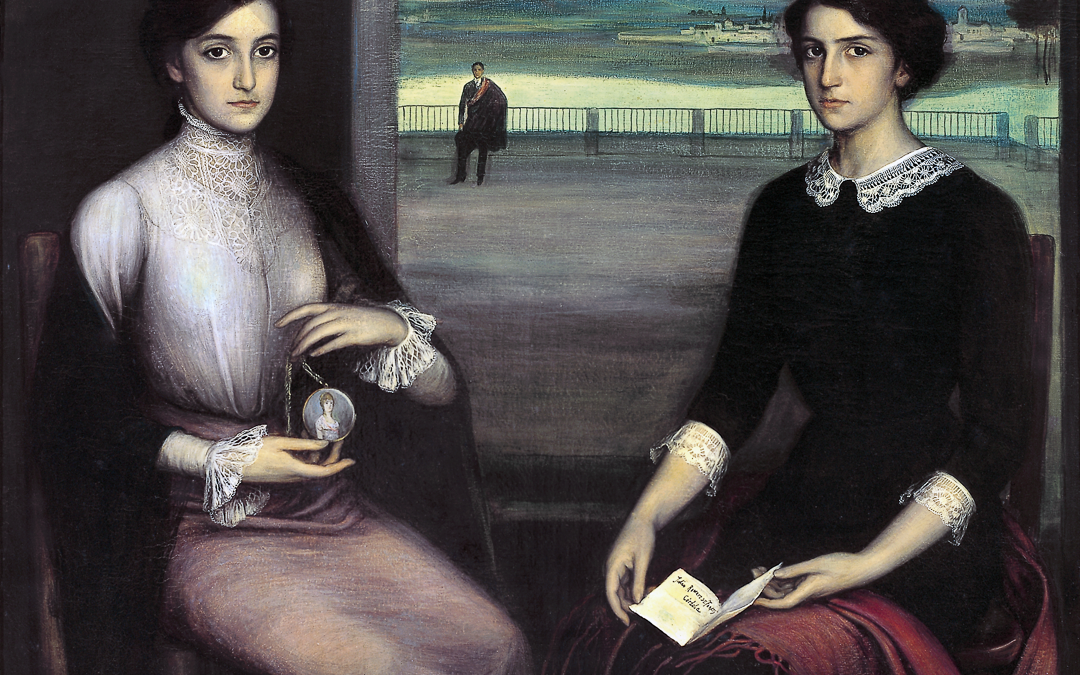
This work from 1909, “Ángeles y Fuensanta,” appear in the scene seated next to the windowsill where it can be made out through the darkness of the dusk at the river’s bank, the Campo de la Verdad and in the distance the hills of the Visos. Angeles, on the left,...
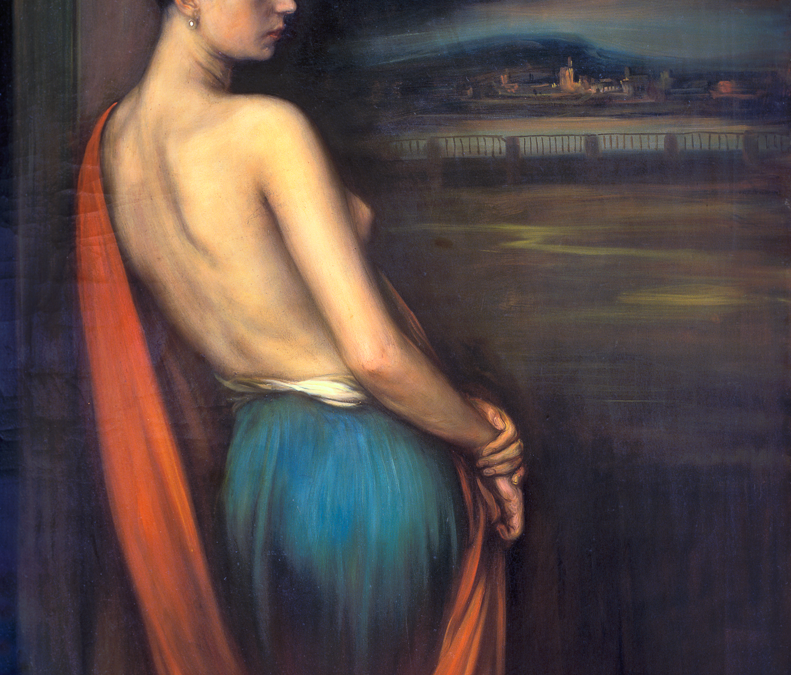
The artist put special attention on this painting, from 1928. This is a piece from the peak of his career in the period of the artist. Visitors can observe how the characteristics of his style evolve in chromaticism, dark tones, and in the treatment of the figures....
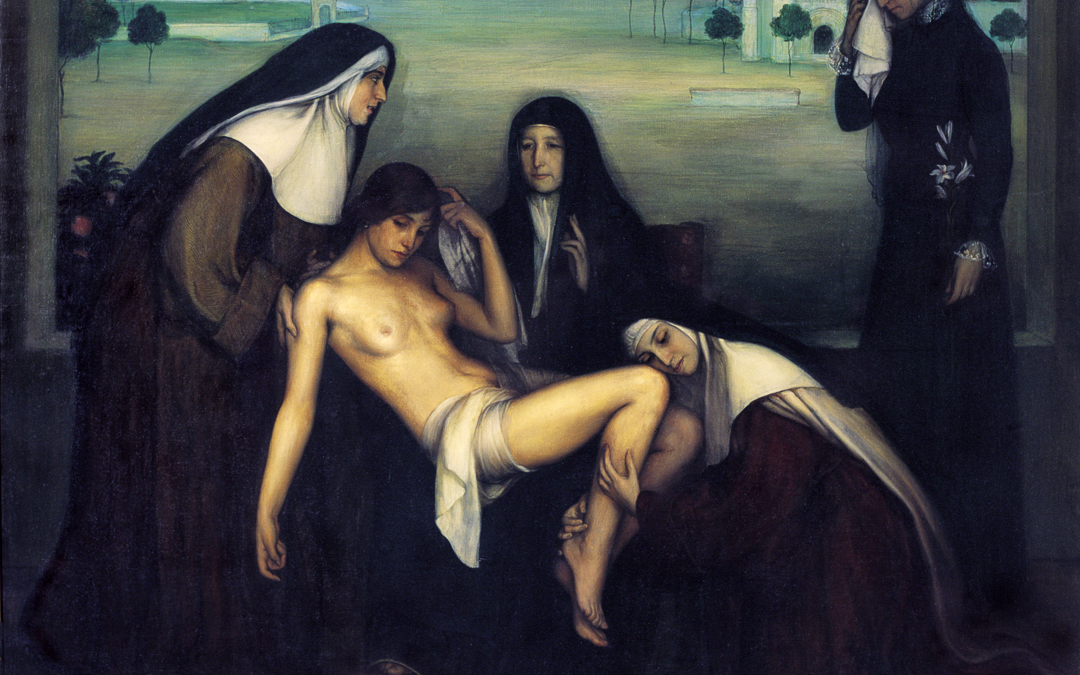
This painting forms a trilogy together with “The Sin” and “The Two Pathways”. The subject is mystic love and profane love and women are the protagonist of this duality. He uses for this reason the same model as in “The Sin”; a...
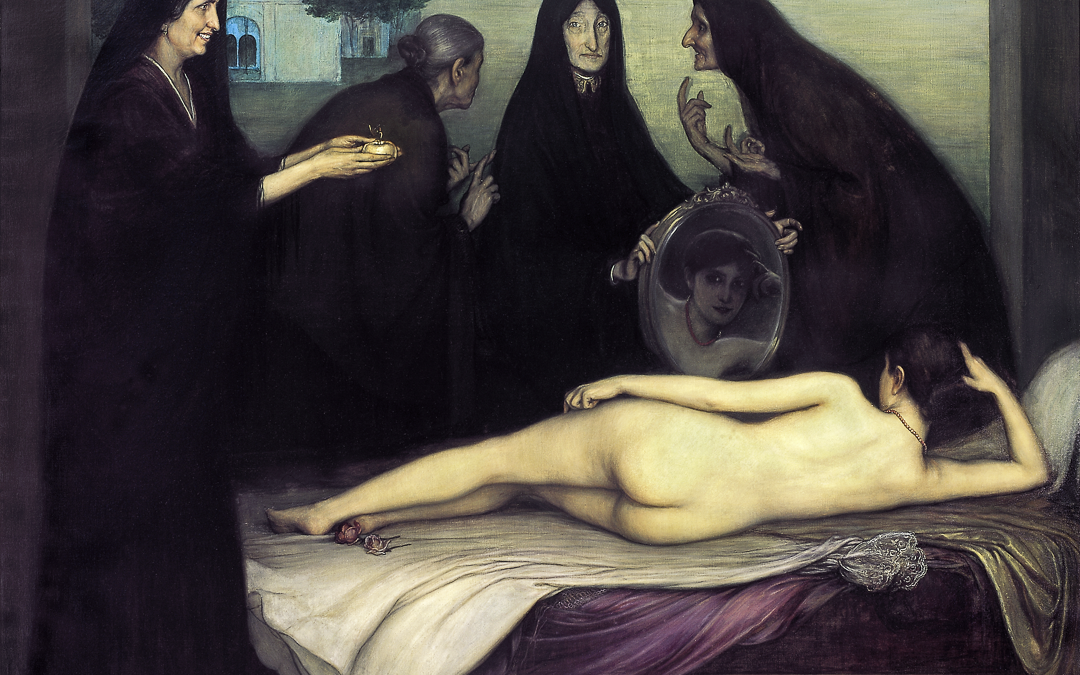
This piece from 1915 is a product of the painter’s period of artistic maturity. Julio Romero de Torres conceived the piece, “El Pecado,” (The Sin) as a complement to the painting, “La Gracia,” (Grace). Great great symbolist as he was, Julio Romero de Torres expresses...