
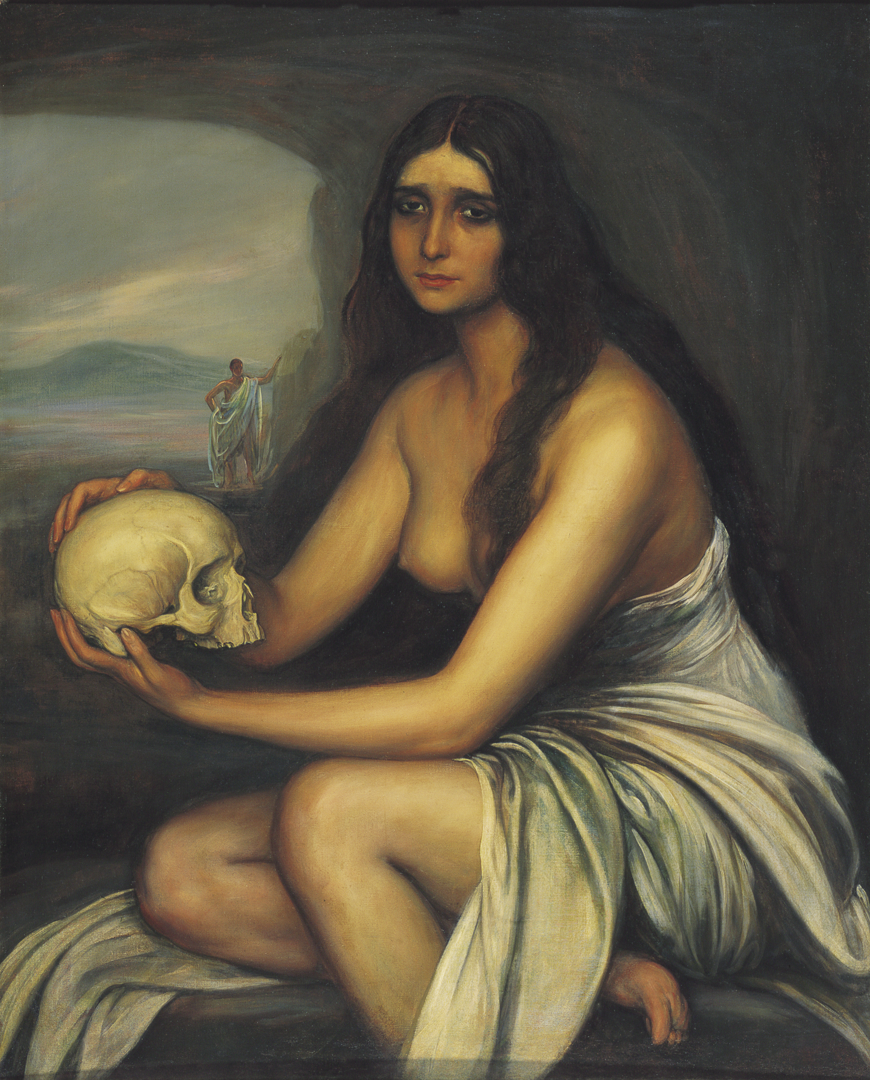
Religion, as part of the beliefs and symbol of popular culture, occupies a prominent place in the production of Julio Romero de Torres. Like many of the painters of fin de siècle symbolism, he was interested in biblical themes, in the representation of hagiography and in local devotions. In his work he resorts to a compendium of iconography presented in a very personal way that balances between the rigor of the Catholic devotional tradition and the daring of a fetishistic and sensual treatment that is almost irreverent, although deeply rooted in the Andalusian collective imagination.
In this canvas from 1920, a penitent saint is represented in a cave, with a skull in her hands, with long hair, with a dress and a cloak that leave her semi-naked. Spirituality and eroticism masterfully coexist in the character with a serene and realistic expression. The iconography it presents conforms to that of the penitent Magdalene; Although, due to the character that appears in the background, it can be related to Saint Mary of Egypt, this being Zosimus of Palestine after offering his cloak to the saint in the Jordan River.
For the representation of the protagonist he used a dancer of Catalan origin called Minerva as a model.